

Table of Contents
- The Reality of Firefighter Family Life
- Challenges of Being a Firefighter Wife (or Partner)
- Firefighter Shift Work Marriage Tips That Actually Hold
- Parenting on a Firefighter Schedule
- Firefighter Family Mental Health Resources
- Financial Planning for Irregular Income and Side Hustles
- Is Firefighter Family Life Worth It? Building a Resilient Family Unit
- Conclusion
Last Updated: August 28, 2026
The Reality of Firefighter Family Life
Firefighter family life is one of the most demanding domestic arrangements in any profession, not because of danger alone, but because of the structural chaos the schedule creates. The 24/48 and 48/96 schedule doesn't just reshape a firefighter's week, it reshapes the entire family's relationship with normalcy. This guide covers the real challenges, the strategies that actually work, and the honest answer to whether firefighter family life is worth the sacrifice.
The 24/48 and 48/96 Schedule: What It Actually Looks Like
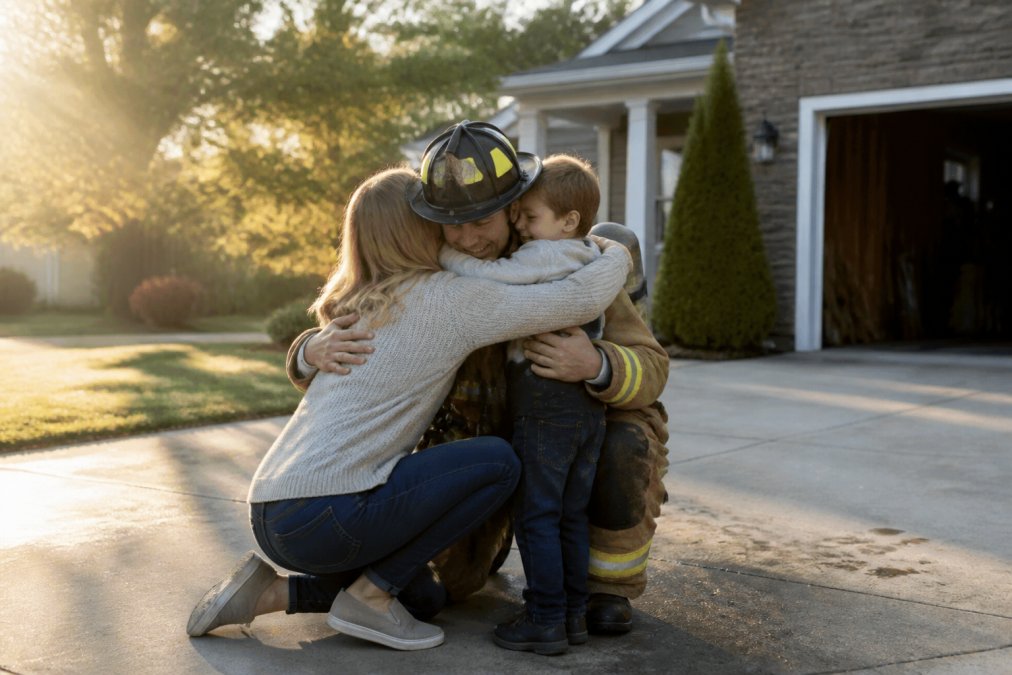
The 24/48 schedule means a firefighter works 24 hours on shift, then has 48 hours off. The 48/96 variation doubles that: two days on, four days off. On paper, it sounds generous. In practice, the day after a 24-hour shift is largely a recovery day, leaving one genuinely productive day off before the cycle starts again.
For families, this means the household runs on two completely different rhythms. The partner at home manages school drop-offs, dinners, bedtimes, and emergencies alone on shift days. The firefighter returns home depleted, sometimes needing hours of quiet before they're fully present. Many families describe this not as a schedule but as a lifestyle adjustment with no off switch.
Missed Milestones and Holiday Shifts
Holiday shifts are among the most cited stressors in firefighter households. Birthdays, Thanksgiving, Christmas Eve, school plays, the shift calendar doesn't negotiate. One missed birthday is manageable. Five years of alternating holidays creates a pattern that children notice and partners quietly absorb. According to the U.S. Fire Administration's firefighter wellness resources, shift work and schedule irregularity are among the leading contributors to family stress in the fire service.
The families that navigate this best treat the calendar as a tool, not a constraint. They create substitute celebrations and protect those dates with the same seriousness as the real ones.
Challenges of Being a Firefighter Wife (or Partner)
The challenges of being a firefighter wife are real, specific, and often invisible to outsiders. The role demands self-sufficiency combined with genuine tolerance for uncertainty.
Emotional Detachment and the Transition Phase
The transition phase is the period immediately after a firefighter returns home from shift. A firefighter who has just spent 24 hours managing emergencies, sleeping in a communal space, and operating at high alert doesn't instantly switch into "present parent" mode. The nervous system needs time to downshift.
Partners who don't understand this often interpret the detachment as disinterest. That misread is one of the most common sources of conflict in firefighter marriages. The detachment isn't personal, it's physiological. The most effective approach is to build a deliberate buffer into homecoming routines. Some families give the firefighter 30-60 minutes of quiet before expecting full engagement. Others have a simple ritual, a walk, a cup of coffee, a brief debrief, that signals the transition is happening.
Building Self-Sufficiency Without Feeling Alone
Self-sufficiency is often framed as a strength. For firefighter partners, it's more complicated. The practical reality is that the partner at home must function as a single parent on shift days. Over time, this builds genuine competence and genuine isolation.
The risk isn't incompetence, it's disconnection. When a partner becomes too self-sufficient, they stop looping the firefighter into family decisions. The firefighter feels sidelined. The partner feels unsupported. A support network outside the marriage is essential: other firefighter families, neighbors, close friends who understand the lifestyle. According to the National Volunteer Fire Council's family support resources, peer connection among firefighter families is one of the most effective buffers against isolation and burnout.
Firefighter Shift Work Marriage Tips That Actually Hold
The most durable firefighter shift work marriage tips share one common feature: they're built around the schedule, not against it. Trying to maintain a "normal" marriage rhythm while working a 24/48 is a losing battle. The couples who thrive redesign their expectations entirely.
Communication Patterns That Work Across 24-Hour Gaps
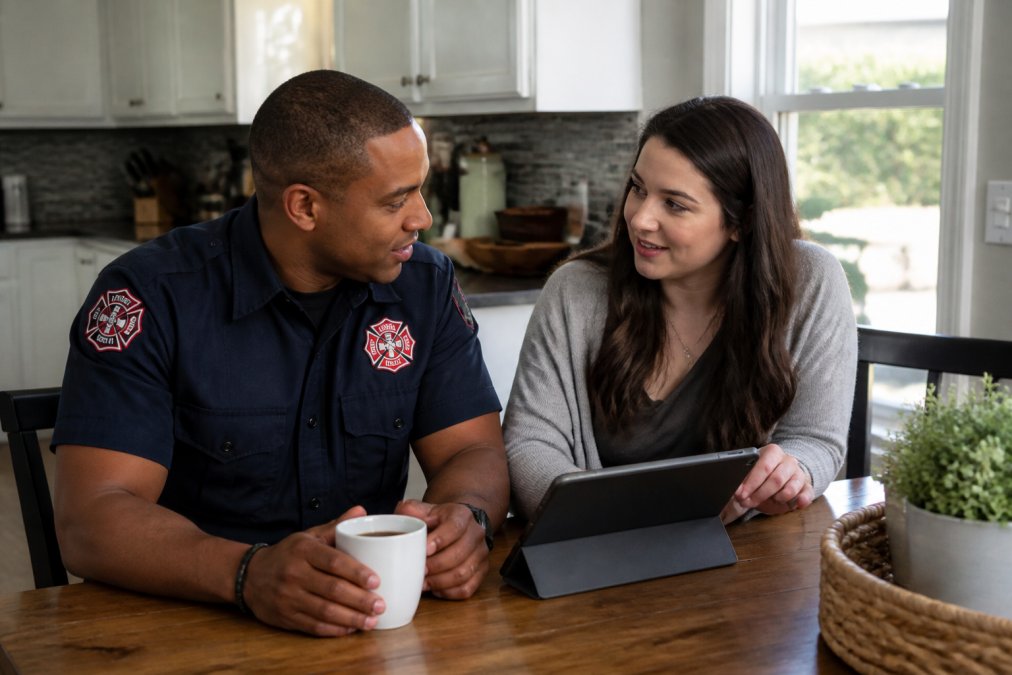
Communication in a firefighter marriage can't rely on spontaneous conversation. The communication patterns that actually work tend to be structured and low-pressure: a morning check-in text at the start of shift, an end-of-shift debrief covering logistics and kid updates, and a weekly "state of us" conversation that's protected time where both partners share how they're actually doing.
The goal isn't constant contact. It's consistent, meaningful contact. Many firefighter couples report that the quality of their communication improved once they stopped trying to replicate what a 9-to-5 marriage looks like.
Technology and Digital Connection Tools
Technology has genuinely changed what's possible for firefighter families. Shared digital calendars eliminate scheduling confusion. Family coordination apps let the partner at home document what's happening so the firefighter doesn't return to a gap in family life. Video calls during slower firehouse moments let parents read bedtime stories or help with homework from across town.
| Tool Type | Best Use | Practical Example |
|---|---|---|
| Shared calendar app | Schedule coordination | Sync shift rotations with school events |
| Family messaging group | Daily updates | Photos, quick notes during shift |
| Video calling | Bedtime routines | Reading to kids from the firehouse |
| Shared task app | Household management | Assign and track home responsibilities |
| Journaling app | Emotional check-ins | Async sharing when calls aren't possible |
Parenting on a Firefighter Schedule
Parenting with a chaotic shift schedule requires a different framework than most parenting books address. What works instead is routine within unpredictability. The bedtime routine stays the same whether the firefighter is home or not. The rules stay the same. The expectations stay the same. Children adapt remarkably well to a parent's absence when the structure around them remains stable.
The harder challenge is parenting across the emotional gap. Children of firefighters often develop anxiety around shift days. Naming the schedule explicitly, at an age-appropriate level, reduces that anxiety considerably. "Dad works at the firehouse tonight and comes home tomorrow morning" is more reassuring than silence. Older children often develop pride in the career, but that pride can mask unspoken fears about danger. Regular, honest conversations about what firefighters actually do on most shifts keeps the relationship grounded in reality.
Firefighter Family Mental Health Resources
Firefighter family mental health is a serious, underserved area. The psychological impact of shift work, chronic stress, and exposure to traumatic events doesn't stay at the firehouse.
New Recruits vs. Veterans: Different Pressures, Different Needs
The mental health challenges in a firefighter family shift significantly over the course of a career. New recruits and their families face the steepest adjustment curve. The schedule is new, the firehouse culture is unfamiliar, and financial pressure is often acute. Peer support from other new firefighter families is the most effective resource at this stage.
Veterans and long-tenured firefighters face different pressures. Cumulative exposure to trauma, the weight of career longevity, and the gradual erosion of emotional bandwidth are the primary risks. According to the Substance Abuse and Mental Health Services Administration's first responder resources, first responders show elevated rates of PTSD, depression, and substance use compared to the general population, and these rates increase with years of service. For veteran families, the challenge is recognizing that what looks like "just how he is now" may be untreated cumulative stress. Many departments now offer Employee Assistance Programs and peer support programs specifically designed for long-tenured firefighters.
Financial Planning for Irregular Income and Side Hustles
Financial planning is one of the most practical dimensions of firefighter family life. Base pay varies significantly by department, region, and rank. Overtime is common but unpredictable. Many firefighters supplement income with side work during their off days.
The families that manage this well treat the base salary as the floor, not the budget. Household expenses are planned around guaranteed income. Overtime and side hustle income goes toward savings, debt reduction, or specific goals. A few practical principles that hold across most firefighter households:
- Build a six-month emergency fund before committing to any fixed lifestyle expense increase
- Track shift-day expenses separately; many families find hidden costs that aren't visible until budgeted explicitly
- Disability insurance matters more than most firefighters acknowledge; a line-of-duty injury can eliminate income overnight
- Side hustles should have defined hours; the 48 hours off after a shift are precious family time
A financial advisor familiar with first responder compensation structures is worth finding early in a career.
Is Firefighter Family Life Worth It? Building a Resilient Family Unit
Is firefighter family life worth it? The honest answer is that it depends entirely on how the family is built around the career, not whether the career is present.
Firefighter family life is worth it for families that approach it as a shared identity rather than a sacrifice one person makes for another. The couples and families that thrive aren't the ones who suffer through the schedule. They're the ones who redesigned their expectations, built genuine support systems, and made the career part of the family's story.
Resilience in a firefighter family isn't a personality trait. It's a set of practices: consistent communication, deliberate transition rituals, honest conversations with children, financial discipline, and the willingness to ask for help before pressure becomes a crisis. The schedule strips away the optional parts of a relationship and forces clarity about what actually matters.
For those in the fire service community, ElBomberoUSA's El Bombero Limited-Edition Challenge Coin, a collectible tribute honoring the 343 and the brotherhood of the fire service, is one tangible way to carry that identity with pride.

The question isn't whether firefighter family life is hard. It is. The question is whether your family has the tools, the communication, and the shared commitment to make the hard parts worthwhile. Most do. But it takes work that starts before the first shift.
Firefighter family life asks more of a household than most careers ever will. The schedule, the emotional demands, and the cumulative weight of the job are real challenges that deserve honest acknowledgment. For families building that life, the ElBomberoUSA community exists as a space that honors the fire service with the seriousness it deserves. Explore the El Bombero Limited-Edition Challenge Coin as a tribute to the sacrifice and brotherhood that define this career, and get started with ElBomberoUSA as a way to carry that pride forward.
Frequently Asked Questions
How does the 24/48 or 48/96 shift schedule impact family dynamics?
The 24/48 schedule means a firefighter works a 24-hour shift, then has 48 hours off. The 48/96 doubles that. Both create an irregular rhythm that families must plan around. Birthdays, school events, and anniversaries will occasionally fall on duty days. The key is building predictable routines on off-days and using shared digital calendars so everyone knows what to expect well in advance. Consistency in the time that is available matters more than the total hours at home.
What are the most common stressors for firefighter spouses?
The biggest stressors reported by firefighter spouses include managing the household solo during long shifts, worrying about safety on the job, handling emotional detachment when a firefighter returns from a difficult call, and feeling isolated from a support network that understands the lifestyle. Missing holidays and children's milestones adds cumulative strain. Connecting with other first responder families, whether through local spouse groups or online communities, consistently reduces that sense of isolation and helps partners develop realistic expectations for the career's demands.
What support systems are available for families of first responders?
Several organizations offer direct support for firefighter families. The National Fallen Firefighters Foundation provides peer support programs and resources for surviving families. The First Responder Support Network runs residential retreats addressing trauma and burnout. Many fire departments now offer Employee Assistance Programs (EAPs) that include counseling for spouses and children. Online communities and firefighter spouse Facebook groups also provide day-to-day peer support. For mental health specifically, therapists who specialize in first responder families offer the most targeted help for firefighter family mental health challenges.
Is the sacrifice of firefighter family life worth the career rewards?
For most firefighter families who build strong communication habits and realistic expectations early, the answer is yes. The career offers job stability, a defined pension in most departments, genuine community respect, and a sense of purpose that carries over into family identity. The firehouse culture of brotherhood also creates an extended support network. The trade-off is real: missed events, shift work stress, and psychological weight from emergency calls. Families who treat those challenges as manageable rather than insurmountable consistently report that firefighter family life is worth the investment.
This article was written using GrandRanker